
Technical Domains
Home > Expertise
Technical Domains
Senior-level advisory and technical expertise in geology and petrophysics.
Advanced Petrophysical Analysis & Reservoir Evaluation
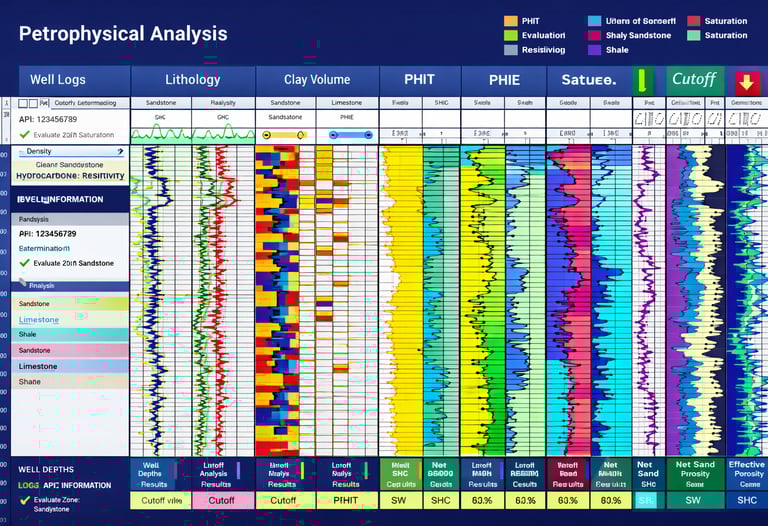
I provide integrated petrophysical analysis focused on delivering defensible rock and fluid property interpretations that support reservoir characterization, development planning, and volumetric assessment.
My work begins with disciplined log conditioning and data quality control, including log cleaning, normalization, depth alignment, and zonation. Establishing consistent and calibrated inputs ensures that subsequent modeling and property calculations are technically sound and scalable across wells.
I apply both deterministic and stochastic approaches to evaluate mineralogy, porosity, and fluid saturation. Mineral modeling, volume of clay determination, and TOC analysis are used to constrain rock composition, while porosity and water saturation calculations define effective reservoir quality and hydrocarbon distribution.
Where appropriate, probabilistic modeling is incorporated to quantify uncertainty and generate statistically defensible property ranges. This approach is particularly valuable in heterogeneous or unconventional reservoirs where single-solution interpretations can be misleading.
My petrophysical contributions support:
Log Data Conditioning & Calibration
Stratigraphic Property Framework Development
Mineralogical & Organic Content Characterization
Porosity & Fluid Distribution Modeling
Reservoir Quality & Net Pay Definition
Hydrocarbon Volume & Resource Assessment
Probabilistic & Uncertainty-Based Analysis
Integrated Log Model Development
The emphasis is always on technical rigor, calibration to core and laboratory measurements, and integration with geological and geomechanical workflows to ensure reservoir properties are both accurate and decision-relevant.
Geologic Analysis & Subsurface Framework Interpretation
I provide foundational geologic interpretation that supports integrated subsurface workflows across geophysics, petrophysics, and geomodeling. My work focuses on defining structural architecture, stratigraphic relationships, and regional controls that establish the framework for quantitative reservoir evaluation.
Geologic analysis begins with basin-scale evaluation, including sediment sourcing, transport direction, depositional architecture, thickness trends, and tectonic influences. Understanding these regional drivers provides the context necessary to interpret local reservoir distribution and structural complexity.
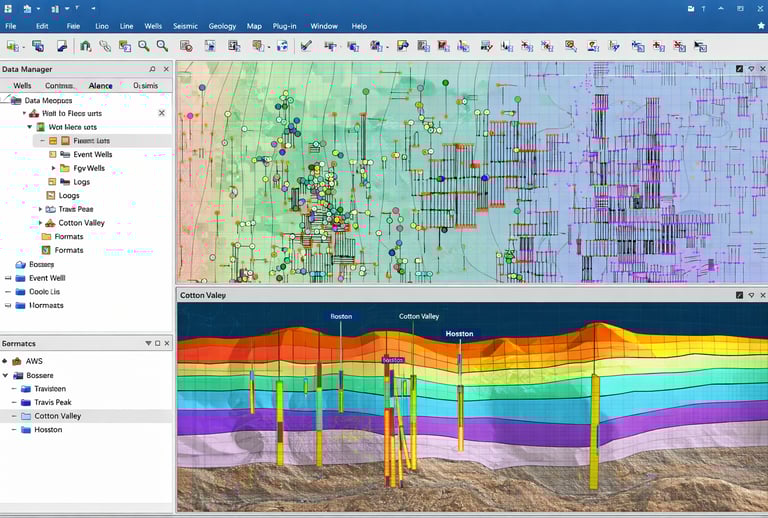
At the field and prospect scale, I conduct structural and stratigraphic analysis through contour mapping, isochore mapping, facies and lithofacies mapping, and cross-sectional interpretation. These interpretations define rock unit continuity, pinch-outs, thickness variations, unconformities, and stratigraphic architecture.
Historical data integration and offset well analysis are incorporated to ensure interpretations are consistent with production performance and subsurface control. When applicable, regional and local principal stress trends are evaluated to inform geomechanical and development considerations.
My geologic analysis supports:
Basin and play-scale evaluation
Structural framework construction
Stratigraphic correlation and cross-sections
Facies and depositional environment interpretation
Reservoir characterization
Production and injection performance interpretation
Integrated inputs for geophysics, petrophysics, and geomodeling
The emphasis is on disciplined mapping, data integration, and geologic reasoning that provides a defensible foundation for quantitative reservoir modeling and development planning.
Geomechanics & Rock Property Evaluation
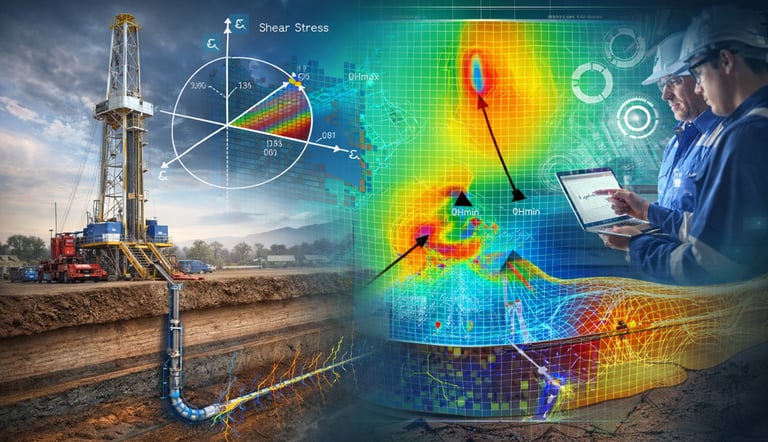
I contribute to integrated geomechanical evaluations by linking petrophysical interpretation with rock mechanical properties and in-situ stress characterization. My work supports the development of calibrated mechanical earth models (MEMs) that inform drilling, completion design, and reservoir management decisions.
Using well logs, core measurements, and laboratory data, I help derive dynamic and static mechanical properties, including Young’s modulus, Poisson’s ratio, compressive strength, and brittleness indicators. Log conditioning and normalization are critical to ensuring mechanical properties are consistent and scalable across wells.
I also support pore pressure estimation, stress gradient evaluation, and fracture characterization through integrated log analysis and rock property modeling. When combined with geological framework interpretation, these inputs help define stress regimes and mechanical stratigraphy within the reservoir.
My geomechanics-related contributions support:
Mechanical Earth Model development
Drilling risk mitigation
Completion optimization and stage design
Fracture barrier identification
Wellbore stability analysis
Reservoir stress characterization
The focus is always on disciplined data conditioning, calibration to core and lab measurements, and delivering mechanically consistent inputs that reduce operational uncertainty.
Geomodeling & Earth Model Integration
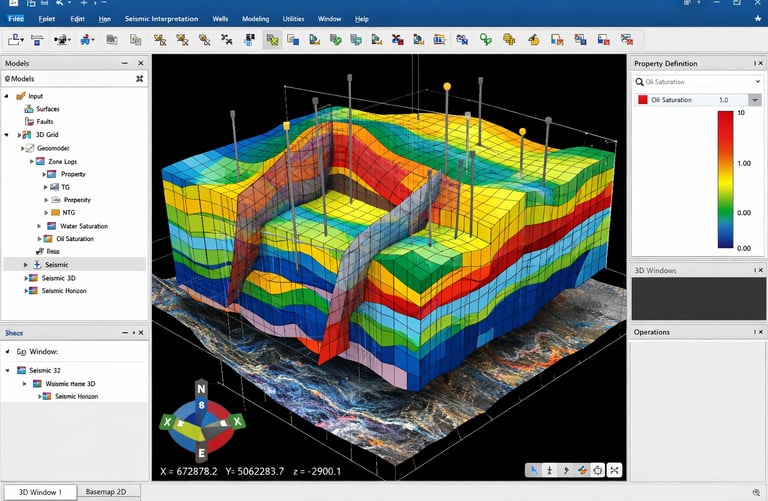
I support the construction of integrated earth models that combine geological framework interpretation with calibrated petrophysical properties. My work ensures that structural architecture, stratigraphic correlation, and depositional facies interpretations are populated with consistent and defensible rock and fluid properties.
From a petrophysical perspective, I focus on delivering normalized and uncertainty-aware inputs, including porosity, water saturation, mineral volumes, net-to-gross, and permeability transforms. Core-log integration and probabilistic modeling approaches are applied to maintain consistency across wells and reduce scaling bias.
By aligning geological interpretation with quantitative reservoir properties, I contribute to earth models that support:
Reservoir volumetrics and net pay mapping
Property distribution modeling
Development planning and well placement
Simulation-ready model inputs
Technical due diligence and risk assessment
My approach emphasizes disciplined workflows, data conditioning, and uncertainty management to ensure models are both technically rigorous and decision-relevant.
Advisory & Professional Engagements
In addition to ongoing technical work, James L. Hawkins provides advisory support in petrophysics, geomechanics, and integrated subsurface evaluation.
Professional engagements are conducted through Core Geologic. For collaboration inquiries or project discussions, please use the contact form.