Petrophysics vs. Geology: Two Perspectives on OOIP — One Shared Goal
James L hawkins
12/15/20251 min read
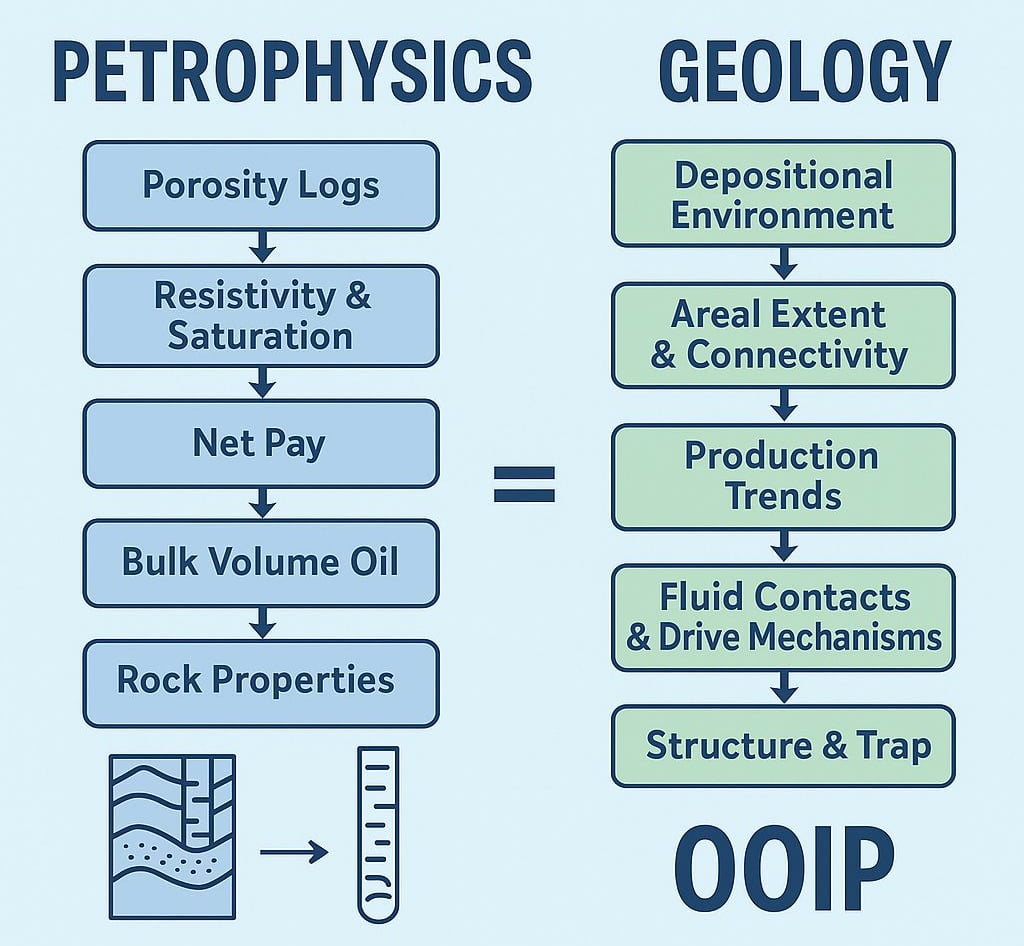
One of the things I’ve always appreciated about multidisciplinary teams in the subsurface world is how differently we approach the same question. A perfect example is Original Oil in Place (OOIP) - a number that drives everything from development planning to reserves booking to economic forecasting. But how we arrive at that number depends heavily on our discipline.
The Petrophysics View: OOIP from the Logs Up
Petrophysicists tend to see OOIP as a rock- and measurement-driven calculation. It starts with the tools:
· Phi from porosity logs
· Sw from resistivity and saturation models
· Net pay cutoffs based on log signatures
· Bulk volume oil derived directly from log-scaled rock properties
· Height, thickness, and facies derived from log character
From this perspective, OOIP is fundamentally a static volume — a snapshot of what the rocks should be capable of storing based on their measurable properties. The focus is on accuracy, calibration, and ensuring the physics supports the interpretation.
The Geologist’s View: OOIP from the Reservoir’s Behavior
Geologists often look at OOIP through a field-scale, dynamic, and depositional lens — integrating:
· Depositional environment & reservoir architecture
· Areal extent & connectivity of sands
· Production trends & decline behavior
· Fluid contacts, aquifer strength, & drive mechanisms
· Structure and trap geometry
Instead of starting with logs, geologists often start with maps, cores, and production performance, treating OOIP as something that must match how the reservoir actually behaves — not just what the logs predict.
To geology teams, OOIP is validated by flow, not just by phi-h.
When the Two Perspectives Meet
When petrophysics and geology collaborate, the result is far more powerful:
✔️ Log-derived rock properties
+
✔️ Reservoir-scale understanding of continuity and production performance
= A realistic, technically defensible OOIP estimate.
This is the intersection where the subsurface story becomes clear — and where asset teams make their best decisions.
At the end of the day…
Petrophysicists quantify the potential.
Geologists validate the performance.
Together, we define the opportunity.